

The United Nations Security Council (UNSC) meeting on the Eastern Mediterranean: Day One
- Tiago Carvalho
- 4 de jul. de 2021
- 3 min de leitura
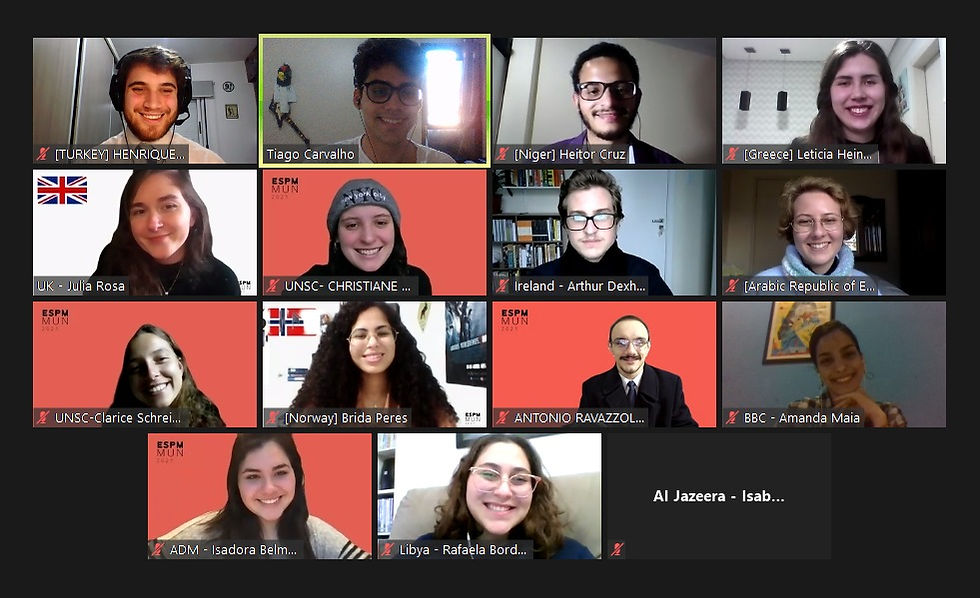
The United Nations Security Council meeting on the Eastern Mediterranean crisis took place during this Saturday (03/07) in the attempt of continue to build a consensus for this long-lasting conflict. Delegates gave their greeting speeches in the morning, announcing a general search for peace, demilitarization and freedom of trade in the region.
The main topics of discussion on the conference’s agenda are: “Encouragement of talks concerning maritime borders”, “Natural resources on the Eastern Mediterranean” and “The Security of refugees”. Nations pretend to tackle long-lasting problems such as the formation of energy alliances, the construction of pipelines to harvest natural gas and the rising militarization in the Aegean Sea.
Greece took advantage of Turkey’s absence in the morning period to propose a solution on its benefit on the militarization of the Aegean Sea. A document with possible solutions to solve the “tensions between Greece and Turkey on the recognition of continental shelves” and “demilitarization of islands in the Aegan Sea” shows strong measures to be taken against Ankara. The proposal attempts to oblige the Turkish nation to sign UNCLOS III, withdraw their troops from the territory of Cyprus and “recognize the unlawfulness of its presence so far”.
The document also proposes to immediately start applying economic sanctions until the conditions are met or a minimum time period is ended. This document is bound to highly escalate tensions on the Eastern Mediterranean.
Still in the morning period, breaking news on an accident on a refugee boat that was on its way to the Greek island of Lesbos stirred the debate on the UNSC. Many casualties had already been confirmed as the boat reached a very short distance from the Turkish coast. The nations on the Security Council agreed to discuss this matter on further basis.
Little minutes later another crisis was revealed to the committee: a new oil reserve was discovered closely to Cyprus’s coast. The new natural resources fountain may contribute to increase tensions between Turkey and Greece, which were already overlapping themselves on the possession of most of the region’s territories. The UNSC spoke that this matter was to be included and solved on the recent proposal constructed by Greece in cooperation with Egypt and the United Kingdom.
The session was resumed in the afternoon with a long debate that revisited Turkey’s and the United States’s decision on not signing the UNCLOS III. After Turkey’s long-awaited arrival, The Greek and British delegates induced strong pressures on Ankara to recognize the existence of continental shelves, affirming that “otherwise demilitarization will not be reached”.
Shortly after the delegates were once more surprised by the arrival of breaking news that revealed that an Israeli army had shot down a Turkish ship on what resembled a war gesture. The ship named Kirmizi Deniz carried supplies to Gaza, a territory currently occupied by Israel. The delegate of Turkey affirmed the need for all the presents to “to apologize to Turkey and demand justice from Israel”.
In a direct response, Greece denied its apology, stating that Turkey is not in any way different from Israel as both nations promote genocide and unlawful occupation.
Another shocking set of news undermined Greece’s alliance with Egypt later on the afternoon as mass protests on Egypt took down the military regime represented by Al-Sissi, which supported Greece in the Cyprus situation. Mohammed Badie assumes power as the new president representing the Islamic Brotherhood and pledging alliance towards Turkey.
To clarify today’s events, The Washington Post sat alongside the BBC and Al Jazeera to interview a few delegates from the UNSC. A press conference was held with Lybia, UK, Greece and Turkey to obtain some answers on the tense events of today’s afternoon and create a more solid perspective on what the meeting may or may not reach. This content will be available tomorrow morning.
Russia’s late appearance on the committee already shook the debate once more, giving a solid preview of what we might see during tomorrow’s sessions.
The afternoon ended with the adjournment of the session reaching a short consensus on refugee crisis. We have strong hopes that tomorrow will follow on this great momentum.

Comentários